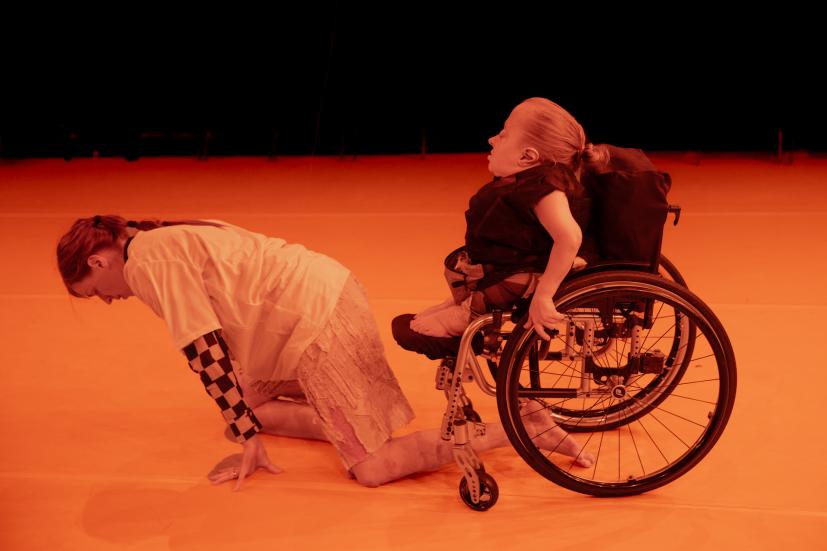
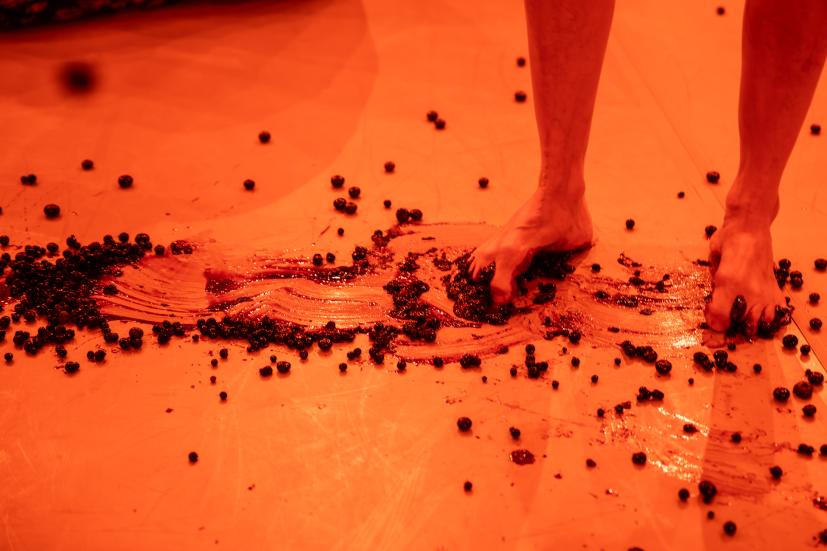
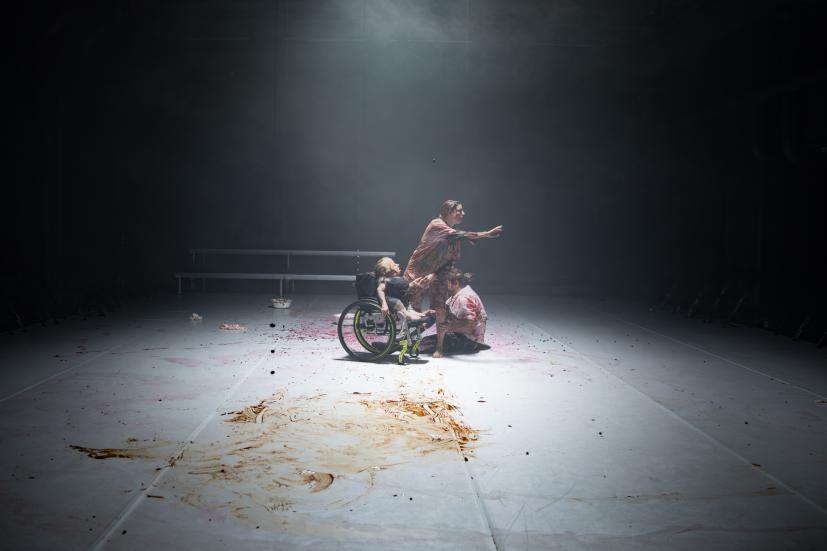
Mess and Love is a performance in which performers with different ways of moving eat, make a mess, nurture each other – and look for ways how to face an unknown future.
Mess and Love – a collaboration between choreographer Kati Raatikainen, scenographer and artist Milla Martikainen, and their working group – ponders how it feels to live as a human being in a time of climate and environmental crises. The mess humanity has made is irreversible; we cannot simply swap a damaged ecosystem for a new one.
Mess and Love sketches a human being who is sincere, dependent, desiring, and destructive, placing sensuality and destruction side by side. It proposes a different kind of humanity: one in which responsibility and pleasure together reshape our relationship to the systems that fail to recognise the interdependence of people and ecosystems. The work asks: what is life like in a changed world? Is it possible to act in a way that treats all people as equally important?
The work explores the cycle of nourishment through the transformation of edible materials. The choreography is guided by the mouth. The mouth binds our bodies to ecological connections. The mouth searches for something to eat, acting as a passage between nourishment, sound, the air we breathe – the internal and external. The mouth connects people and most other animals to the evolution of movement. The mouth makes a mess, sucks, bites, licks, and wonders. Everything passes through the mouth and our bodies.
Mess and Love continues the collaboration between Raatikainen and Martikainen on ecologically sustainable working practices, the accessibility of performing arts, and existing with the grief and sense of helplessness evoked by the polycrisis.
The work has been inspired by artist and researcher Sunaura Taylor’s book Disabled Ecologies which places ecology and disability theory in dialogue. Taylor emphasises that ecosystems disabled by humans are a material reality present in both human bodies and living environments. Taylor also argues that people living with injury and impairment are indispensable producers of knowledge when building new forms of community and care in a changed world.
The working process has focused on sustainable working methods that accommodate different needs. Some of the performers use wheelchairs.
Accessibility and performance notes
The performance contains eating, playing with food, making a mess, loud sounds, theatre smoke and strong lights.
The mess will take place mostly within the stage area. Singular blueberries, that are used in the peformance, can land in the auditorium.
You are welcome to bring your own hearing protection with you. Earplugs are also available at the venue.
The audience is asked to leave their shoes in the coat rack located in the foyer. The rack will be locked for the duration of the performance.
The audience will be seated around the stage and the performers.
All kinds of reactions to the performance are allowed.
You are welcome to arrive 15 minutes early to explore the space before the performance begins.
The performance is non-verbal and lasts approximately 60 minutes. It is followed by a post-show event lasting roughly 30–45 minutes, with the exception of the premiere on Friday, August 21.
English-language post-show events will take place on Wed Aug 26, Fri Aug 28, Sat Aug 29, Tue Sep 1, and Thu Sep 3. These sessions will be facilitated by social anthropologist Patricia Scalco (University of Helsinki), who invites the audience to stay a little longer and explore what the performance has left with us after the applause. As our different impressions meet, we may discover something none of us could have seen alone.
Finnish-language post-show events include an Afterglow discussion on Tue, August 25, hosted by Jarkko Partanen with guest speaker Aura Raulo, an evolutionary biology researcher and artist from the University of Oxford. A Finnish-language artist Q&A session will be held on Wed, Sep 2.
Plain language summary
Mess and Love is a performance in which performers move in different ways. Some of the performers use wheelchairs.
The performance is about a world that is changing. The climate and seasons are changing. Animals and plants are disappearing. The familiar environment is starting to feel strange.
The performance asks what life is like in a changed world. Could we treat everyone as equally important? Could we show that same respect to the environment and animals? Could we care for nature the same way nature feeds us? Everything in the world depends on everything else.
The performance shows that everything in nature works in cycles. Humans are part of these cycles.
The mouth plays an important role in the performance. The mouth eats, breathes, and makes sound. It connects humans to the rest of nature.
The performance includes eating, playing with food, and loud sounds. You can bring earplugs or headphones with you.
You can arrive 15 minutes early to explore the performance space before the performance begins. You can leave the performance and return if needed.
Video: Sinem Kayacan
Sound: Markku Essel
Choreography: Kati Raatikainen
Lighting and spatial design: Milla Martikainen
Performers: Elina Hauta-aho, Kadar Khristan, Noora Västinen
Sound design: Markku Essel
Costume design: Piia Rinne
Sewing assistance: Veera Vuorisalo
Mentor for performers’ work: Taru Aho
Anthropological contextualization and audience facilitation: Patricia Scalco
Consultant for intimacy choreography: Kaisa Kukkonen
Producer: Rosaliina Elgland
Production: Zodiak – Center for New Dance, Kati Raatikainen, Milla Martikainen
In collaboration with: Humina Association
Supported by: The Finnish Arts and Culture Agency, Otto A. Malm Foundation, Taiteilijan taikasauva Project / Kone Foundation, The Regional Dance Centre of Ostrobothnia
PREMIERE